Detroit, MI — When it comes to the food scene of Detroit, it’s apparent that it has developed and grown exponentially in recent years. There’s been an explosion of new restaurants, mom-and-pop eateries, and renowned chefs throughout Corktown, Midtown, Downtown, Rivertown, and neighborhoods throughout the city as its resurgence continues.
Detroit is now home to various cuisines and representations of cultures, whereas 20 years ago, Detroit was mainly known for only a few restaurants and its pizza, Coney, and sliders. Nowadays, people have options from fine dining to Cuban, Thai, Vegan, Japanese, burgers, Italian, chic fusion joints, Argentinian, breweries, steakhouses, and more. And while the burgeoning food scene has done its best to keep up with the renewed growth of the city, there is (and likely always will be) room for improvement.
When I moved back to Metro Detroit in the Fall of ’22, I started following as many local food bloggers and influencers as possible on social media for food and restaurant recommendations. One of the first profiles I discovered and followed was Jonathan Kung, a self-taught chef known for his third-culture cooking. Jon has amassed over 2 million followers for his social media cooking videos and content creation. Of the various content creators I followed, I always found Jon’s approach to cooking very personable and loved how he weaved his background as a Chinese-American into his cooking to make his way as a chef in Detroit.
FULL SECTION: MI Foodie Adventures Video Projects
Following a work initiative in mid-March that put me in touch with Jon’s team, I mentioned that I ran a food blog as a side passion and inquired about interviewing Jon for a feature on his life and personal insight on how Detroit’s food scene has evolved over the years. Once Jon returned to Detroit from a recent book tour, I arranged a luncheon with Jon in downtown Detroit. I suggested that we meet at a restaurant of Jon’s choosing, to which he suggested Eatóri Market, which just reopened following a months-long closure for a remodel and expansion. I enlisted the help of my buddy and outstanding photographer Logan Tesmer (he helped me shoot the DWC and Rising Stars Academy feature), and before long, we were rolling out to downtown Detroit.
We headed downtown Wednesday morning on April 3rd, set to meet Jon at 11:30 a.m. at the market. Logan and I were fully geared with our gimbals, tripods, lav mics, and (most importantly) phones fully charged. I rarely visit downtown Detroit during the weekdays, so I was quickly enamored with the midday pulse of the city as Logan and I briskly walked past Capitol Park and into the market. As we walked in, I saw Jon just ahead, who walked in probably just 30 seconds before us. We met up and exchanged introductions, but alas, the bubbled excitement of the moment burst after we realized that the renovated dining side didn’t appear to be open yet for the day!
It turns out that the restaurant/bar side is only a happy hour/dinner venture, while the market hours are open to close. But don’t worry, after seeing Eatóri Market’s expanded menu debut, I can definitely say that I’ll be circling back soon for a future foodie adventure. Nonetheless, our spirits quickly recovered, and we decided to pivot and go to the nearby cocktail bar SPKRBOX for a coffee and casual chat.
The noisy bustle and sunny warmth of midday were abundant in downtown Detroit that day as the three of us walked north toward SPKRBOX. This bright-orange-themed, large, open-windowed establishment juts right up to the intersection of Grand River Avenue and Griswold Street. SPKRBOX is a cozy space that serves as a coffee shop by day and as a Detroit techno club at night. Jon and I both ordered while Logan deferred. I hadn’t had any coffee yet for the day, so I eagerly ordered a cold brew.
RELATED: Cuban-inspired Frita Batidos serves up some hearty chorizo burgers in downtown Detroit
Logan and I followed Jon to the upstairs/second level of the corner bar and found a place to sit. Logan and I had determined beforehand that we’d spend some time just chatting and getting to know Jon for a bit before actually setting up and conducting the interview. As Logan and I would eventually conclude after discussing how things went post-interview, we immediately noted Jon’s very relaxed and chill demeanor from the second we sat down at SPKRBOX.
We sat and discussed a range of topics with Jon. We weren’t recording during this time, but as Logan helped me recall, we chatted about the challenges and rising living costs in downtown Detroit compared to other major cities. Jon’s lived downtown for quite a few years and remembers a time when he paid under a grand in monthly rent. I’ve had similar conversations within the past year with many Detroiters who live or work in the city, and the views and visions for the city are often identical. There is a drive within this city to get on the level of other major cities like Chicago. While aspiration remains high, the surge in living expenses for downtown remains out of reach for most and boxes out several income brackets. While the city has come a long way, we all agreed that for where prices are these days, things like public transit, access to food/groceries, affordable housing, parking, and even infrastructure could all be better. Since background music was playing overhead and throughout the shop, we decided to change venues once it came time to record.
We departed SPKRBOX in search of a quieter space to conduct the interview. As we three pondered and walked east along Grand River, Jon suggested the lounge at the Shinola Hotel as we reached Woodward Avenue. Since I’ve been back, I’ve heard nothing but great things about the Shinola Hotel, so I was excited to two-stone the situation — getting to check out the hotel while also having its swanky interior serve as the backdrop for the interview.
We set up in the lounge area, which was filled with folks reading, working, and groups of people conversing about their days. The warm lighting and ambient setting fit the vibe for this interview perfectly: a new-era boutique hotel in downtown Detroit, one of the many beacons of change throughout the city on the rise, paired with a proud Detroiter and chef who has witnessed and participated in the evolution of its food scene.
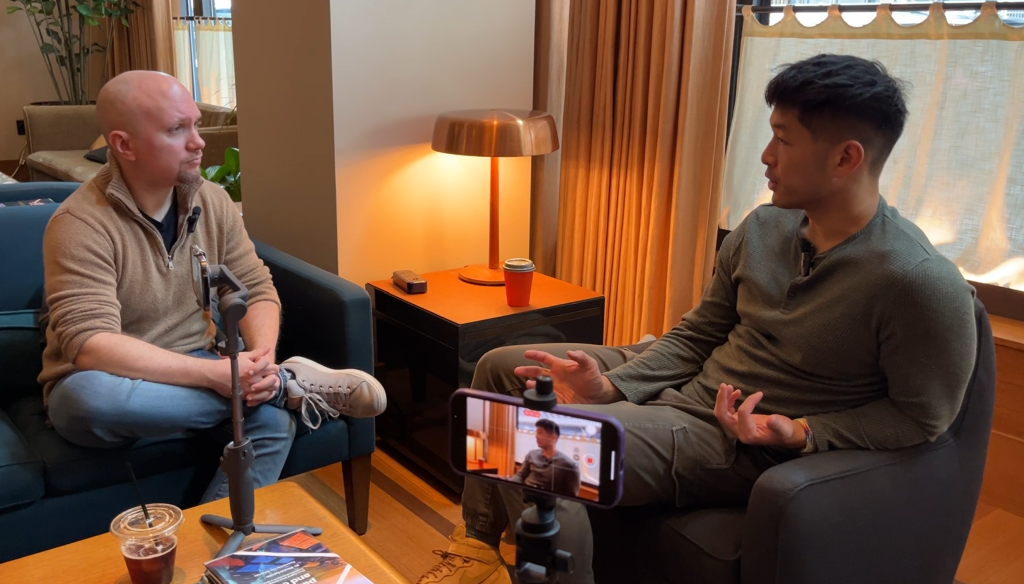
I started the interview by asking about Jon’s early life and what led to Detroit becoming his home. He explained to me that he and his family moved around a fair bit when he was young, even leaving Los Angeles only a few weeks after being born. Jon’s family spent some time between Hong Kong and Canada, but since he was the only American citizen in his family, Jon says he decided to attend college in the United States. Before long, he found himself in Michigan, earning a degree in theater arts and creative writing from Eastern Michigan and a law degree from the University of Detroit Mercy.
During his time in college, Jon says he often cooked for his roommates, taking an even greater interest in cooking when he was in law school. This led to Jon defining and developing his third-culture cooking style and his signature niche: Kung Food. I asked Jon to break down what being a third-culture cook means to him and how it helped influence his method of cooking.
“Well, the constant moving around, the constant shifting between different cultures and our kind of re-evaluation of what home and family was all the time. When I was younger it was very difficult because it left me with no sense of really belonging anywhere. But as I grew older, and as I really started being more confident and sure-footed with my ability to create as a cook, as an artist, whatever, I realized that that emerged. That, like, day-to-day switching between a base culture of your home, which in my case is Chinese, and then the outer, the outside culture of my home, which was wherever in North America, in Toronto, Michigan. That provides you with nuance, and that provides you with so many different perspectives on how people communicate, how people enjoy food, how people share food, and what people value in terms of food; it’s all different,” Jon explained.
Jon said that his cooking became more serious and creative while in law school. As cooking became more intrinsically woven into Jon’s life, it became a vehicle through which he could share his experiences and culture with his community.
“It was the only creative outlet that I felt was productive enough that it wasn’t a distraction from my studies, but it turned out to be a completely different branch of study on its own. And so I was self-taught, just to do like Chinese home cooking at first, and then that graduated to doing pop-ups in the city. There were very few Chinese options here, very few here in Detroit, and so, I wanted to share the food that I knew how to make with some of the neighborhoods. Certainly, at that point in time, we had many open storefronts and it was very, very easy to just like, move into these empty places and just turn it into a restaurant for a day,” Jon said.
Logan and I even got to learn the backstory of how Jon decided on ‘Kung Food’ as his culinary namesake. Several factors contribute to this, including the obvious that his last name is Kung, but also to pay homage to a former ‘Kung Food’ restaurant that existed in Detroit back in the day, according to Jon. He said that the old signage for the former restaurant is reportedly somewhere in DC and that he’d love to find it and get it back to its original home in Detroit someday. I told Jon how much of a fan I was of the name, referencing my background in martial arts and Wing Chun Kung Fu, hence my appreciation for the play on the word food/fu. Jon laughed and shared a story from his shop’s early days; there was a kung fu studio also in Eastern Market at the time, so they often got each other’s intended phone calls.
Reflecting on his Eastern Market beginnings, Jon explained how he got started in kitchens and pop-ups before eventually carving his culinary path.
“My first experience working in Eastern Market was for a secret kitchen called Salt and Cedar. They were a private kitchen and dining room experience behind a letterpress. So, it was already something I’d call millennial whimsical, or it’s like, oh, of course, there is a bookbinder and letterpress next to a chicken slaughterhouse in a Farmers Market in Detroit. And, of course, if you walk through a curtain at the back of this letterpress, there is this giant table surrounded by books and art and artifacts and just this tiny little stove way, way in the back with no ventilation because the whole thing was completely not legal. And not that anything I did after that really was, but that one was particularly because we were serving wine, we were cooking food for people, and it was just like my introduction to the theater of dining,” Jon said.
“So once they closed up shop, I decided to take that model and do my own version of it. And that’s where like Kung Food Market Studio came from, and for that it was pretty much a lot of the same. But it was my food, it was more food focused and that is when I started to do like tasting menus based off of things like Hayao Miyazaki films and stuff. And this was in 2011/2012. So it was still kind of like a novel idea, I think, back then. And it did well locally, like I had a lot of respect in the industry locally. We were all friends with each other. All the chefs that had the biggest restaurants at the time, here we were all hanging out. We’re all doing pop-ups together. And yeah, I just had my little space and it was like a magical time, but it was at the great physical cost of me. I’m still tired from it.”
Several years later, in 2020, Jon and the entire world would encounter the unprecedented: a global pandemic. The pandemic hit the restaurant industry hard, resulting in a lot of chefs, industry staff, and small business owners being couped up and stuck at home as the world stumbled forward in the dark during those uncertain times. During that first year of the pandemic, social media apps, particularly TikTok, exploded in usage in the first couple of months. When certain posts or users became viral (extremely popular and highly viewed content), a new avenue and way to market oneself to larger audiences emerged through the quick, short video swipe/scroll design.
Jon said if it weren’t for being stuck inside during quarantine, he never would have thought to pick up a camera and make videos of himself cooking. But once quarantine began to really sink in for everyone and we lost our connections to the outside world, apps like TikTok took on a whole new meaning. They became gateways for us to stay connected to our communities virtually. Jon, who recalls the days of Vine (the app that arguably paved the way for TikTok), says he saw the potential early on for TikTok, and how quickly TikTok filled a void in people’s lives at the start of the pandemic.
“It became people’s only window to the outside world. And that’s when I was like, okay, this isn’t just a little thing anymore; this has become a community. People were just talking about their experiences during the pandemic, getting to know other people outside of their own homes, their apartments, and stuff, sharing what was going on. Lots of grassroots reporting and news was happening, especially during the Black Lives Matter movement. It was one of the fastest ways to know what was going on,” Jon explained.
Jon described when and why he finally decided to turn the phone around and embark on what would eventually become his new full-time career endeavor.
“I was like, well, this is absolutely special. And so, I wanted to do something. I was stuck inside. I was obviously not feeding anybody or not letting anyone into the studio, but I had this studio space that was just meant to make food in, so I turned the phone around, and I started making these terrible, cringy videos. I remember, they’re still up there; if you scroll down far enough, you’ll see. You’ll see the first one that I was too scared to speak in. I was too scared to show my face in them for whatever reason, and things just started to take off from there. And once things got better, we were allowed to grocery shop. I started going from survival food to the things I had been doing years prior, showing off the food that I was making for the dinners and stuff. Then things really took off. Then, I got my first brand deal partnership, which was with Funimation. At the time, they were the biggest anime distributor in the country, and now they’re merged with someone else. But that’s also when I found out there’s like, oh, this is like a career. And they make a lot more money than cooks do,” Jon said jokingly.
From his humble beginnings at Eastern Market pop-ups, his culinary endeavors, a global pandemic, and his rise as a social media content creator, Jon has experienced a lot over the years as a chef in Detroit. A proud promoter for the city, Jon has also witnessed the evolution of Detroit’s food scene. In a lot of ways, the growth of the city’s food scene mirrors the resurgence of Detroit itself. However, for all the great “new” things around Detroit that we enjoy today, it’s not without its challenges and growing pains.
“Everybody needs to grow up eventually. And the stuff that we were doing then, it took youth, it took excitement, and it took a lot of energy because you need a lot of energy if you’re going to put all of that time and effort into something for that little pay or sometimes no pay. But now this, it’s like the scene matured with us, which I don’t think is an experience that a lot of people can get anywhere else. I’m not saying that there was nothing here in Detroit. There have always been really amazing and interesting things to do here. But the fact of the matter is, we were part of that wave of people who initially brought more, I think, and we were doing it. A lot of us at least were doing it to the best of our ability and service to our communities that had taken us in and had accepted us,” Jon elaborated.
“In my case, it was the market. I feel like I owe that farmer’s market everything because they were just so good to me, so accepting of what I was doing creatively. And so yeah, out from that, I think from those interesting things that we were doing, other people started to take notice. It wasn’t just an outsider’s problematic view of what Detroit was commonly referred to as; no, it was an interesting city. It was an artist’s haven — all of those things. And, of course, after the artist, you get gentrification, and there you go… It’s a story everybody knows.”
READ MORE: A weekend trip to Grand Rapids isn’t complete without a visit to Stella’s Lounge
One of the other growing pains for the food industry in a rapidly expanding city is the quantity of labor. Jon says one of the issues facing the industry in Detroit today is the massive labor shortage that supports the rate of new growth in the city. With more restaurants and acclaimed chefs popping up around the city every month, we need to ensure proper support systems are in place for owners and employees so that their endeavors can bear fruit — in some cases, literally. Small business owners, especially newcomers, have been getting a lot of support and funding from the City of Detroit in recent years. But, the traditional supply and demand model comes into play if/when Detroit reaches a point where the supply far outweighs the demand. Jon and I agreed that while the abundance of restaurants is, in some ways, a good problem to have, the demand needs to exist in order for businesses to survive and ensure their employees are being paid the wages they deserve to make a living in today’s economy.
Jon and I discussed how the city must also address food deserts in neighborhoods and increase access to groceries downtown. Simply put, if the city wants more people to come and live downtown, it needs to show that it can support the population size it desires and that it can support the people who already live in Detroit. Another area Jon says he’d like to see improved, even more diverse food options around downtown. While more international/regional options have started popping up in the city, for some cuisines, you still have to drive out into various suburbs and counties to find what you’re looking for.
While there is room for improvement, the City of Detroit has come a long way in the last five to ten years at an exponential rate. Chefs and restauranteurs like Jon have been along for the ride, evolving and establishing themselves like the city. But not every chef or restauranteur has stayed. One of the most important discussions in Michigan these days is retaining our talent and younger workforce. Jon mentioned how this applies to the restaurant and food industry because talented folks have been forced to leave our state far too often to make it in bigger food markets like Chicago or New York.
“I would like to see Detroit and the outer suburbs realize that the most interesting things that come out of this city oftentimes have to leave to be recognized by people within Michigan themselves. We have a huge problem in recognizing local talent to the point where people here will ignore a promising, young, chef-driven restaurant downtown, but they’ll line up around the block for Shake Shack,” Jon explained. “There’s nothing wrong with Shake Shack, but at the same time, it’s like everyone here; they just fall into the trap of being a basic bitch who just looks for brand recognition. There’s so much creativity here in this city that we need to foster it, and we really need to stop telling them to leave first. We don’t tell them outright, but through our own actions, we tell them to leave, and then they make it big outside, and hopefully, they come back.”
Our interview with Jon went for over a half hour, so there is a lot more I could write about or include, but instead, I summarized the main takeaways as best I could. Hearing Jon advocate for the homegrown talent of Detroit and our state was inspiring. I believe it’s folks like Jon who should also be invested in because chefs like Jon champion the cause of establishing Detroit as a food city, which he does very well on TikTok. While it’s debatable whether or not Detroit is already established, time and public perception will tell as the city gears up to host significant events this year, like the upcoming NFL draft later this month.
After three years as a content creator, Jon says he often gets asked what his next move will be, but he has no plans to leave Detroit anytime soon. Jon has made many great contributions to the city’s food scene and continues to promote its culinary greatness to the world via social media. He said he still feels a lot of support from around Detroit and the food community, adding that the ways in which he was able to grow as a chef in Detroit, he wouldn’t have been able to experience in any other city. The evolution of Detroit yielded, in turn, a generation of chefs who evolved with it and are now doing their part to give back to their community. Logan and I wrapped up our interview and thanked Jon for his time and for coming to meet with us for the story, which ended up being an evolution trifecta, evolving from its original plan of a simple lunch into seeing and exploring more notable establishments around Detroit — a city where change is evident, common, and constant. Now, THAT is what I call a foodie adventure!
For more details on the life and works of Jonathan Kung, click here. For more information about Eatóri Market, click here. Additional information on SPKRBOX can be found by clicking here. And finally, to learn more about Shinola Hotel, click here.
 MI Foodie Adventures
One response to “Conversations with Jon Kung: Detroit chef shares his culinary journey and discusses the evolution of the city’s food scene”
Another great article 👏, really enjoyed the read. Reminds me of my favorite Dumplings and Hand Pulled Noodles in Metro-Detroit. Highly recommend a visit 👌 here’s my review Enjoy https://www.instagram.com/p/CiQxd92gOOS/?igsh=MXVqcmh0ZmlrYzlmMQ==
LikeLiked by 1 person